A River's Story, Carved in Stone
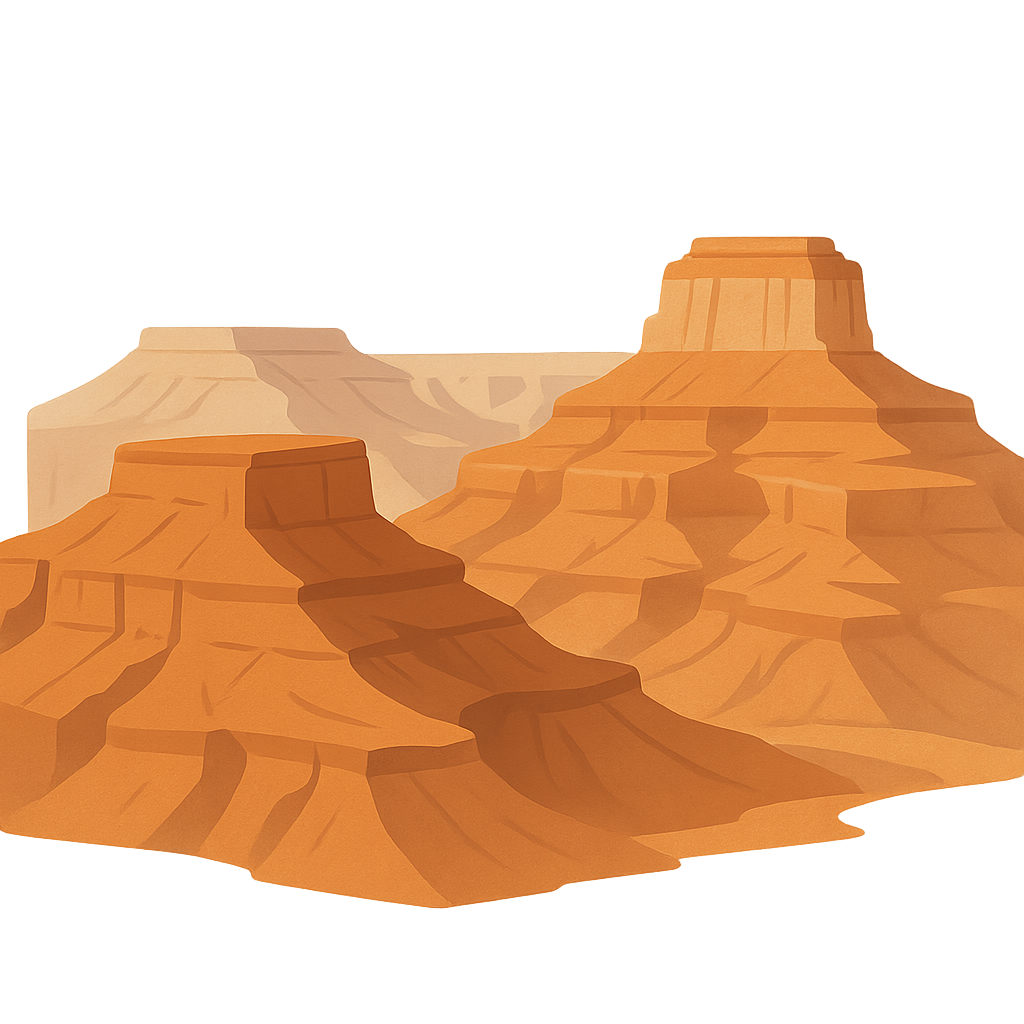
I am a giant chasm carved into the earth, a wound of spectacular beauty. I stretch for 277 miles under the vast Arizona sky. At sunrise, my stone walls blush with soft pinks and purples, and as the sun climbs higher, they burn with fiery oranges and deep reds. By sunset, long shadows paint me in shades of violet and blue. The wind whispers secrets through my countless side canyons and towering buttes, a sound that has echoed here for ages. Far below, in my deepest, darkest corners, you can hear a constant, powerful murmur—the sound of the great river that created me, a relentless force still shaping me today. Listen closely, and you will hear my name on the wind. I am the Grand Canyon.
My story did not begin with a single, dramatic event. It began with a patient artist: the Colorado River. For nearly six million years, this river has been my sculptor. Imagine a tiny stream of water flowing over a vast, high plateau. Day after day, year after year, century after century, that water carried away tiny grains of sand and silt. This slow, steady process, called erosion, is my secret. The river was like a saw, cutting deeper and deeper into the land, revealing layers of rock that tell the story of the Earth itself. My walls are a history book written in stone. Each layer represents a different era—some were once ancient seabeds, others were coastal plains or vast deserts of sand. At my very bottom, you can see the oldest pages of this book: the dark, twisted Vishnu Schist, which is almost two billion years old. The river exposed this incredible timeline for all to see, a masterpiece millions of years in the making.
Long before explorers from other lands arrived, my ledges and caves were a home. For thousands of years, people have lived within my walls, their lives woven into my very existence. The Ancestral Puebloans were some of the first, arriving over 4,000 years ago. They built homes, called cliff dwellings, tucked into my natural alcoves, high above the canyon floor. For them, I was not just a place to live; I was a sacred space, a source of life, and the center of their spiritual world. They grew crops on the canyon floor and hunted along my rims. Today, their legacy lives on. Indigenous tribes like the Havasupai, who still live deep within my side canyons, the Hualapai on my western rim, and the Navajo Nation to my east, continue to see me as a living, breathing entity. To them, I am a sacred place of origin and healing, a connection to their ancestors that must be honored and protected.
For centuries, my existence was known only to the people who called me home. Then, in 1540, new eyes gazed upon me for the first time. A Spanish explorer named García López de Cárdenas, part of Coronado's expedition searching for cities of gold, stood on my South Rim. He and his men were stunned by my size, but my steep, treacherous walls defeated them. They tried for days to reach the Colorado River far below but could not find a path down. They left, and for more than three hundred years, I remained a mystery to the outside world. That all changed in 1869 with the arrival of a man as rugged as my own cliffs: John Wesley Powell. He was a scientist, a professor, and a Civil War veteran who had lost his right arm in battle. Driven by scientific curiosity, he led a daring expedition of nine men in four small wooden boats down the treacherous, uncharted Colorado River. For three months, they battled ferocious rapids, lost boats and supplies, and faced starvation, all to map my winding path and study my geological secrets. Powell’s journey revealed my true nature to the world, transforming me from a blank spot on the map into a geological wonder.
Once John Wesley Powell shared my story, people began to understand my true value. Artists came to paint my shifting colors, and scientists came to read my rocky pages. But with this fame came danger—some wanted to mine my resources or build dams that would flood my canyons. A new kind of hero was needed to protect me. In 1903, one of those heroes, President Theodore Roosevelt, stood on my rim and was deeply moved. He declared, "Leave it as it is. You cannot improve on it. The ages have been at work on it, and man can only mar it." His powerful words sparked a movement to preserve my natural splendor. For years, people fought to ensure I would not be changed by human hands. Finally, on February 26, 1919, their efforts succeeded, and I was officially designated Grand Canyon National Park. This act was a promise—a promise to protect my wild beauty for every generation to come.
Today, I stand as a testament to the power of time and the beauty of our planet. Millions of visitors from every corner of the globe come to walk my trails, gaze from my rims, and feel a sense of awe. I am a classroom for geologists, a canvas for artists, and a sanctuary for anyone seeking peace and perspective. When you look out across my vast expanse, you are not just seeing a canyon; you are seeing time itself. You are seeing a story of creation, of persistence, and of the enduring connection between humanity and the natural world. I am a reminder that some treasures are meant to be shared by all, a view that belongs to everyone, for all time.
Reading Comprehension Questions
Click to see answer