Twelve Seconds That Changed the World
My name is Orville Wright, and I want to tell you about a dream that my older brother, Wilbur, and I shared: the dream of flying. It all began not in a workshop or a laboratory, but in our childhood home in Dayton, Ohio. One evening in 1878, our father, who was a traveling church bishop, came home with a gift for us. It was a small toy, no bigger than his hand, made of cork, bamboo, and paper, with a rubber band to power its little propellers. He tossed it into the air, and instead of fluttering to the ground, it shot up and hovered at the ceiling. We were mesmerized. That little toy helicopter, as we called it, planted a seed in our minds that would grow for years. As we grew older, Wilbur and I opened our own business, the Wright Cycle Company. You might think fixing and building bicycles has little to do with flying, but you’d be surprised. Every day in our shop, we were working with principles that were essential for flight. We learned about balance, how a rider shifts their weight to stay upright. We learned about mechanics, how chains and gears transfer power to create motion. And we learned about building structures that were both lightweight and incredibly strong. We didn't know it then, but every bicycle we sold and every problem we solved was preparing us for the much greater challenge that lay ahead: building a machine that could carry a person through the air under its own power.
Our dream wasn't just a fantasy; it was a scientific problem we were determined to solve. We read everything we could find about the work of others, like Otto Lilienthal in Germany, who had made amazing glider flights. Inspired, we began building our own gliders. But turning theory into practice was harder than we ever imagined. Our first gliders didn't produce nearly as much lift as the existing scientific tables said they should. It was frustrating. We realized that if we wanted to succeed, we couldn't rely on anyone else's work. We had to figure it out for ourselves. We needed a place with strong, steady winds and soft sand for our inevitable crash landings. After studying weather charts, we chose a remote, desolate spot on the Outer Banks of North Carolina called Kitty Hawk. It was perfect. For several years, we packed up our lives in Ohio and traveled to that windy coast to test our ideas. The biggest breakthrough came when we questioned the very data everyone else accepted as fact. Back in Dayton, we built a simple but ingenious device: a six-foot-long wooden box with a fan at one end. It was our own wind tunnel. Inside, we tested over two hundred different miniature wing shapes, carefully measuring the lift and drag on each one. This painstaking work gave us the true, accurate data we needed. It also helped us perfect our most important invention: a system we called ‘wing-warping.’ We realized that a pilot needed to control the roll of the aircraft, just like a bird twists its wings to turn and balance. By rigging a series of cables connected to a hip cradle where the pilot lay, we could twist or ‘warp’ the ends of the wings, allowing us to control the machine in the air. This was the key to true, controlled flight.
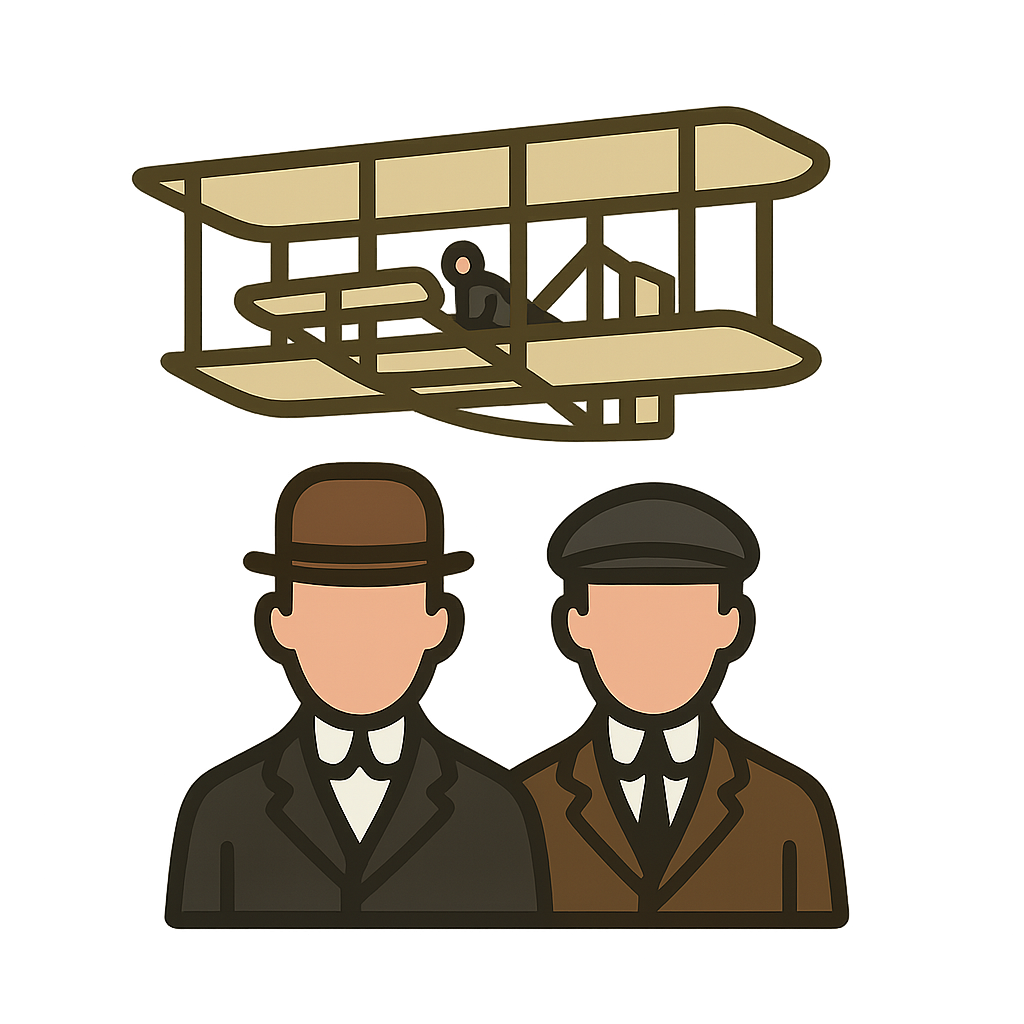
Finally, the day arrived: December 17, 1903. The air at Kitty Hawk that morning was bitterly cold, with a wind gusting over 20 miles per hour. It was so strong we almost considered waiting, but we had come too far to be discouraged. A few days earlier, on December 14th, Wilbur had won a coin toss for the first attempt, but the machine had stalled and suffered minor damage. Now, it was my turn. After helping lay the 60-foot launching rail on a flat stretch of sand, I climbed aboard our creation, the Wright Flyer. I lay flat on my stomach on the lower wing, my hands gripping the controls for the elevator and my hips settled into the cradle that controlled the wing-warping. Wilbur started the small, 12-horsepower engine we had built ourselves in our bicycle shop. It sputtered to life with a roar that cut through the whistling wind. He steadied the wingtip as I released the restraining wire. The Flyer began to move, slowly at first, then faster as it slid down the rail. Wilbur ran alongside, holding on until the last possible moment. Then, I felt it. A sudden lightness, a separation from the earth. The bumps of the rail vanished. I was flying! For twelve seconds, I was airborne, wrestling with the sensitive controls, trying to keep the machine level as it bucked in the wind. I soared over the sand for 120 feet—a distance shorter than the wingspan of a modern jetliner—before gently landing. Those twelve seconds felt like a lifetime. When the Flyer came to a stop, Wilbur rushed over, his face beaming with a mix of relief and triumph. We had done it. We had actually flown.
That first flight was incredibly short, but its importance was immeasurable. We weren't done for the day, though. We took turns, making three more flights. Each one was longer and more controlled than the last. On the fourth and final flight of the day, Wilbur was at the controls, and he flew for an amazing 59 seconds, covering a distance of 852 feet. That proved it. Our success wasn't a fluke. We had built the world's first successful airplane and, more importantly, we knew how to fly it. It’s funny to think that on that cold, windy morning, with only five other people as witnesses, the world had changed forever. Our years of study, our failures, our wind tunnel experiments, and our belief in each other had finally paid off. The dream that began with a simple toy helicopter had opened up the skies for all of humanity. Our journey taught me that with curiosity, perseverance, and a willingness to challenge what everyone else believes is true, even the most impossible dreams can take wing. We had given the world a new age, an age of flight, and inspired people everywhere to look up at the sky and imagine the possibilities.
Reading Comprehension Questions
Click to see answer