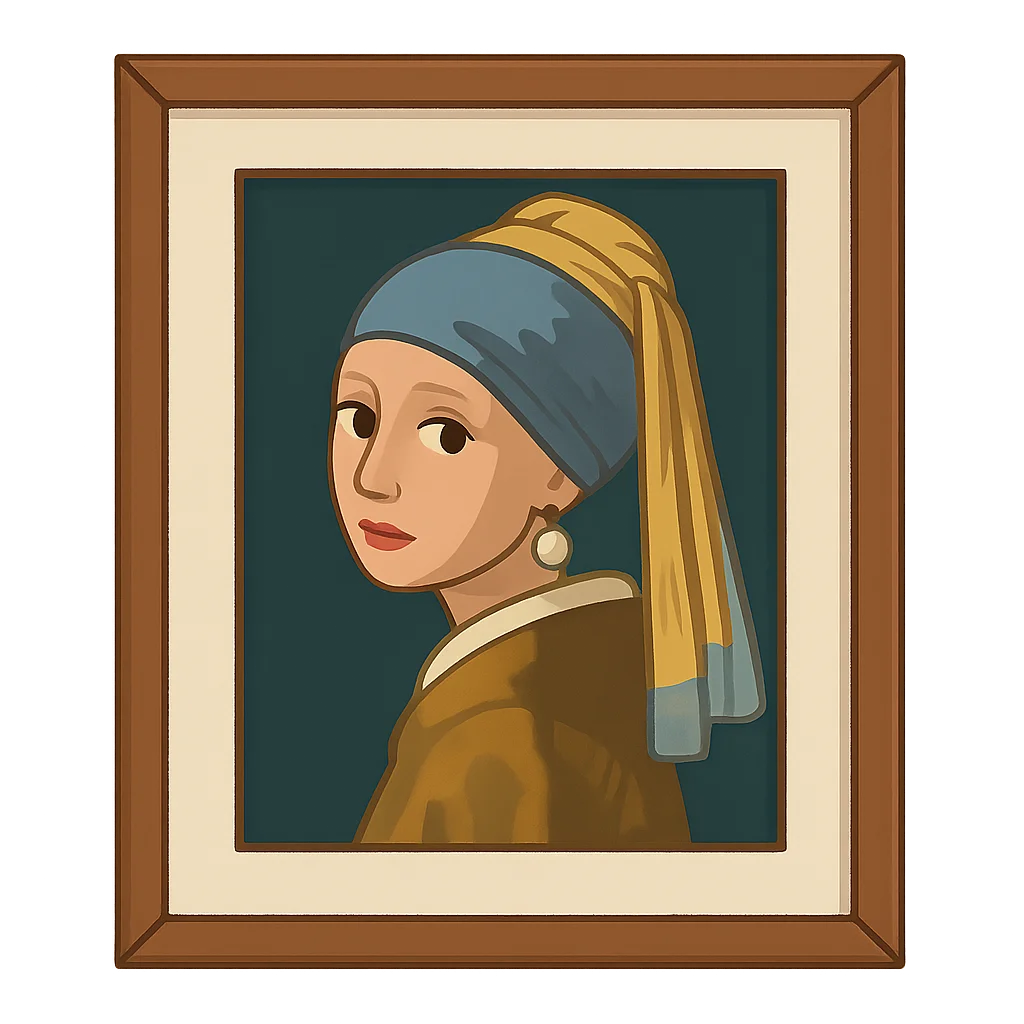
The Girl in the Painting
I exist in a space of quiet darkness, where the only thing that matters is the light. Before you know my name, you see the light as it catches the side of my face, the soft glow on my lips, and the bright spark of my earring. I am a moment, a thought, a question frozen in time. A girl turns her head, her eyes meeting yours across centuries. Who is she? What is she about to say? The fabric of her blue and yellow turban is a mystery, a splash of color against the deep, silent background. And then there is my pearl—or is it? It’s just a clever trick of paint, a few strokes of white that shine with a borrowed light, capturing the reflection of a collar that isn’t even there. I am not a photograph; I am a feeling, an intimate glance that was never meant to last, but has. I am the painting people call 'Girl with a Pearl Earring'.
I came to life around the year 1665, in a busy little city called Delft in the Netherlands. My creator was a quiet, careful man named Johannes Vermeer. His studio was his world, a room filled with northern light that streamed through a window on the left—you can almost feel that same light on my cheek. He wasn't just a painter; he was a master of light. He worked slowly, grinding his own pigments to get the perfect colors. The brilliant blue in my turban came from a precious stone called lapis lazuli, which was more expensive than gold back then. He painted me on canvas, building me up with thin layers of oil paint to create a sense of depth and luminosity. I am not a traditional portrait of a wealthy person who paid for their image to be captured. Instead, I am what was called a 'tronie'—a study of a character, an interesting face, or a curious expression. Vermeer wasn't trying to capture a specific person's likeness for a commission; he was trying to capture a mood, a fleeting human moment that felt universal and timeless. He was exploring how light could reveal emotion and how a simple turn of the head could tell an entire story without a single word.
For a long time after my creation, the world forgot about me. After Vermeer died and was buried on December 15th, 1675, his work fell into obscurity. He had not been widely famous during his life, and his small number of paintings were scattered. I was sold, passed from one owner to another, my true creator’s name lost along the way. For over two hundred years, I waited in the shadows of private collections, my existence unknown to the wider world. I grew dark and cloudy as layers of old, yellowed varnish covered my colors, obscuring the delicate details my creator had so carefully painted. Then, in 1881, a man named Arnoldus Andries des Tombe saw me at an auction in The Hague. I was in poor shape, covered in grime and cracks, but he saw something special in my gaze. He bought me for just two guilders and thirty cents—an astonishingly small sum. He suspected I might be a Vermeer, a treasure hidden beneath the grime. He took me home, and for the first time in centuries, I had someone who truly appreciated me and understood my secret past.
When Mr. des Tombe passed away in 1902, he had no children, and he generously left me to the Mauritshuis museum in The Hague, which has been my home ever since. My journey back to my original self was not yet complete, however. My biggest change came much more recently. In 1994, art doctors, called conservators, gave me a very special cleaning and restoration. It was like waking from a long, dusty sleep. They carefully removed the old, dark varnish that had flattened my appearance for so long. Suddenly, the blue of my turban was brilliant again, the light on my skin was soft and warm, and my pearl earring gleamed with its magical shine. For the first time in modern history, the world could finally see me as Vermeer had painted me on that day in 1665. Now, I hang on the museum wall, and people come from all over the world to meet my gaze. They take my picture, they write stories about me, and they wonder about my secrets, which I keep safely behind my quiet smile.
Why do people still look at me after more than 350 years? I think it's because I am a question that can never be fully answered. Who was the girl? Was she happy or sad? What was she thinking in that split second she turned to look over her shoulder? My creator, Vermeer, gave me a life that extends far beyond the canvas. I am a bridge to the past, to a quiet room in Delft filled with light and the smell of oil paint. I remind people that a simple moment, a single glance, can hold so much beauty and mystery. I am proof that art is not just something you see, but something you feel—a connection across time between an artist, a subject, and everyone who stops to look. It is this connection that keeps the wonder alive.
Reading Comprehension Questions
Click to see answer