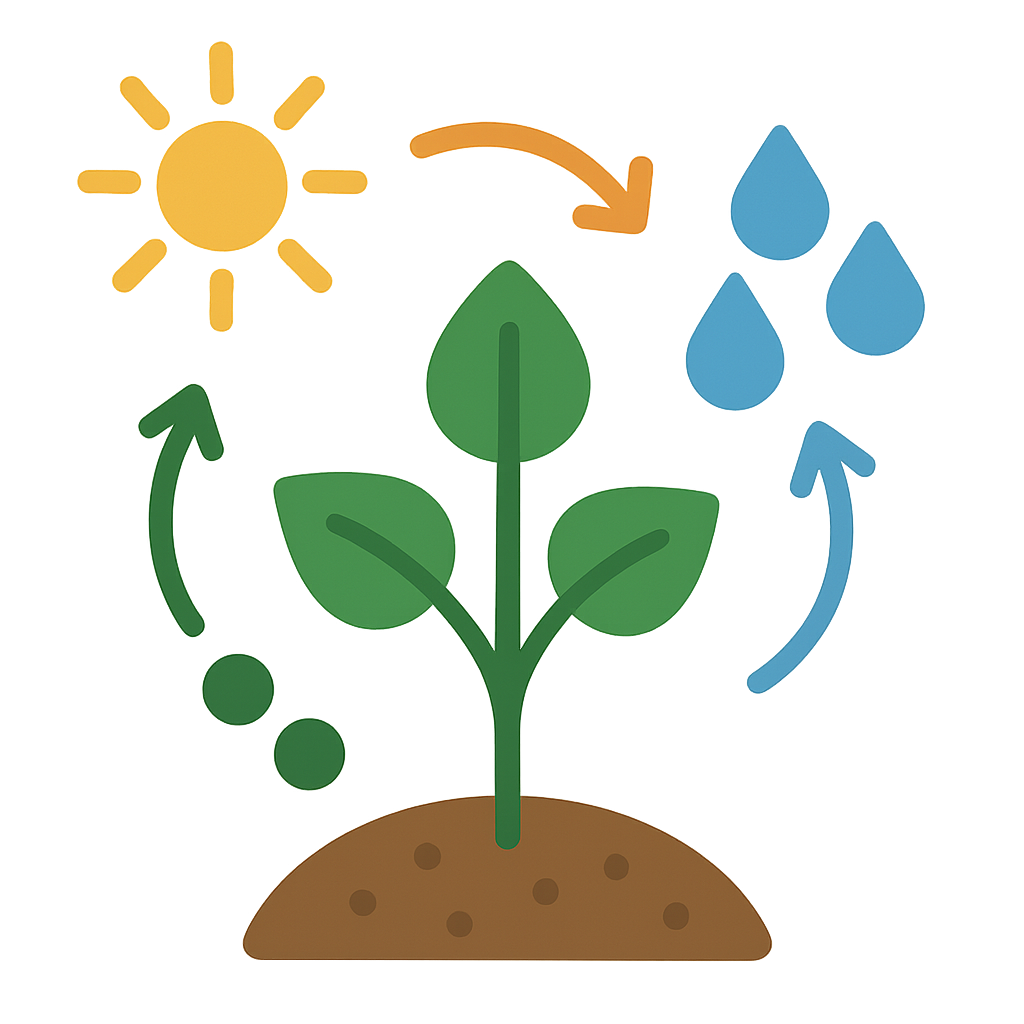
The Secret Chef of Photosynthesis
I am the silent, invisible chef for the entire green kingdom of your world, a force of creation that works tirelessly without ever making a sound. You can’t see me, but you can see my handiwork everywhere you look—in the towering trunk of the oldest redwood, the tender curl of a new fern, the softest blade of grass, and the most delicate flower petal. My kitchen is vast, stretching across every sunlit leaf, every floating lily pad, and even in the tiny algae that drift in the oceans. The vibrant green color you see, a magnificent pigment called chlorophyll, is the very countertop where I prepare my feasts. It’s a magical surface, perfectly designed to catch the sun's rays. I don't use flour or sugar from a bag; my ingredients are the most fundamental elements of your planet. I take the water that travels up from the plant’s roots, a cool, clear liquid drawn from deep within the earth. My main ingredient, however, is a special gift you give me with every single breath you exhale: a wispy, colorless gas called carbon dioxide. My stove is the most powerful one in the universe, not powered by gas or electricity, but by the golden, radiant energy of the sun itself, ninety-three million miles away. I capture its light, using its incredible warmth and power to cook up a very special kind of food. It's a sweet, energy-packed sugar, a simple meal that becomes the fundamental building block for everything the plant needs to grow—stronger stems to reach for the sky, wider leaves to create more kitchens for me, and brilliant blossoms to bring beauty to the world. This meal I prepare is the secret fuel that powers almost all life. But my work isn’t just about feeding the plants. With every meal I cook, I release a special gift, an invisible puff of something precious into the atmosphere. It’s the very essence of a fresh forest breeze, the crisp, clean air that fills your lungs and allows you, and all the animals, to live and breathe. I am the planet's quiet miracle, the cook who feeds the world and freshens its air, one sunbeam at a time.
For millennia, I worked in secret. Humans walked through forests I sustained and breathed the air I cleaned, yet they had no idea how I did it. They saw that plants grew, but the recipe remained a complete mystery. The first person to get a real clue was a curious physician from Brussels named Jan van Helmont, back in the 1640s. He was a meticulous man who loved experiments. He took a small willow tree, weighed it carefully, and planted it in a pot with a pre-weighed amount of dry soil. For five years, he did nothing but give it rainwater. At the end of the experiment, the little willow had gained over 160 pounds, yet the soil had lost only a couple of ounces! He was astonished. He concluded that the tree must have built itself almost entirely out of water. He was only partially right—he didn't know about my other key ingredient from the air—but he was the first to prove that plants didn't just 'eat' soil. His discovery was a giant leap away from old, incorrect ideas. More than a century passed. Then, in the 1770s in England, a brilliant and observant man named Joseph Priestley began playing with what he called 'injured' air. He noticed that if he lit a candle in a sealed glass jar, the flame would soon go out. If he put a mouse in the jar, it would eventually collapse. The air was used up. But then he tried something amazing. He placed a sprig of mint into a jar with the 'injured' air, and after several days, he found he could light the candle again! The mouse could live! The plant had somehow restored the air. He didn't know exactly what the gas was, but he knew I was doing something to make the air breathable again. His work caught the attention of a Dutch scientist named Jan Ingenhousz. In 1779, Ingenhousz took Priestley's work a step further with over 500 experiments. He was the one who uncovered my biggest secret: I need light. He demonstrated that plants only release this air-refreshing bubble of gas when they are in the sunlight. In the dark, they did not. He also figured out that only the green parts of the plant, the leaves and stems, were responsible for this magic. He had put together the main pieces of my puzzle: water, air, and light. Still, I didn't have a proper name. For another century, scientists called me 'carbon assimilation' or other clunky terms. Finally, in 1893, an American botanist named Charles Barnes proposed the perfect name. He combined two Greek words: 'photo,' meaning 'light,' and 'synthesis,' meaning 'to put together.' Photosynthesis. Putting together with light. That was me. After centuries of quiet work, I finally had a name that perfectly described my sun-powered recipe for life.
Now that you know my name and my recipe, you can begin to understand my true importance. I am not just a chemical process; I am the very foundation of life on your planet. Think of a food web. It might start with a rabbit nibbling on clover, which is then eaten by a fox. Where did the energy that the rabbit and the fox depend on truly come from? It came from me. I was the one who took sunlight and turned it into the chemical energy stored in that clover. I am the starting point for nearly every food chain on Earth, from the tiniest insects to the largest blue whales that feed on plankton I have nourished. I am the engine that converts the sun’s distant power into the energy that fuels the entire living world. But feeding the world is only half of my job. My other role is just as critical: I am the planet’s great air purifier. As humans build cities and industries, they release enormous amounts of carbon dioxide into the atmosphere. I breathe it in. I take that gas, which in large amounts can warm the planet, and I lock its carbon away to build the plant’s body. In exchange, I release the gift I mentioned earlier: oxygen. Every breath you take is filled with the oxygen that I, and my countless green kitchens, have produced over billions of years. I help keep the delicate balance of gases in your atmosphere just right for life. This ancient job is more important today than ever. When you see people planting trees in a park or tending a garden, they are giving me more places to work. Every new leaf is another tiny, efficient factory dedicated to cleaning the air and creating the energy that sustains us all. So next time you walk beneath a tree, feel the cool shade of its leaves, and take a deep, fresh breath. Remember me. See each green leaf not just as a piece of a plant, but as a small, bustling, sun-powered factory working tirelessly for you and for the entire planet. I am your quiet partner, a constant, life-giving process that connects the sun, the air, the water, and you.
Reading Comprehension Questions
Click to see answer