The Invisible Architect
Have you ever felt me? I am with you right now, holding you gently to your chair. When you leap into the air, I am the one who makes sure you come back down, your feet landing firmly on the ground. I am the silent partner in every game of catch, guiding the ball in a perfect arc from your friend’s hand to yours. I am a constant, invisible presence, an unbreakable promise that the Earth makes to everything upon it. You can't see me or touch me, but my effects are everywhere. I keep the deep, blue oceans from floating away into space and hold the very air you breathe close to the planet. At night, look up at the Moon. I am the invisible tether that keeps it circling the Earth, a loyal cosmic companion on its endless journey. My reach is vast. I am the reason planets dance in elegant orbits around the Sun, and the reason the Sun itself is held within the swirling arms of the Milky Way galaxy. For thousands of years, humans felt my pull. They knew that what goes up must come down, but they saw it as just a simple rule of the world, not as a profound mystery waiting to be solved. They felt my embrace, but they didn't know my name. I am Gravity.
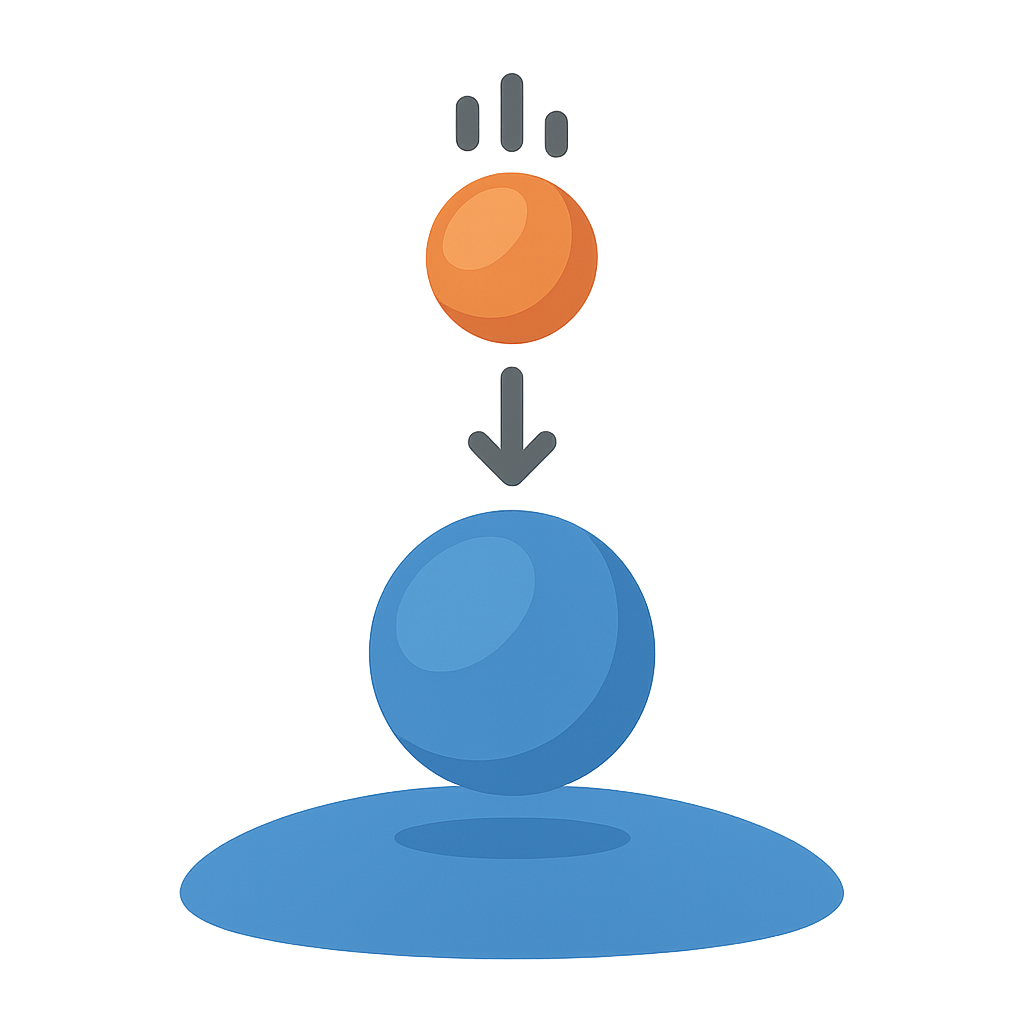
For ages, people accepted my presence without much question. But then, a few curious minds began to wonder. They weren't satisfied with just knowing that things fall; they wanted to know why. The biggest leap forward came from a thoughtful young man in England named Isaac Newton. Around the year 1666, while seeking refuge from a plague that had closed his university, he was sitting in a garden when he saw an apple fall from a tree. For most, this would be an unremarkable event. But for Isaac, it was a spark. He didn't just see a piece of fruit falling; he saw a fundamental question about the universe. He wondered why the apple fell straight down, not sideways or even upwards. Then, his mind made a tremendous leap. He looked up at the Moon, a pale disc in the daytime sky, and asked an audacious question: Is the force that pulls this apple to the ground the very same force that holds the Moon in its orbit around the Earth? In that moment of insight, he realized I wasn't just some local phenomenon limited to our planet. I was universal. He proposed that every object in the universe attracts every other object. The strength of my pull, he reasoned, depends on two things: how much matter the objects have—their mass—and how far apart they are. This was a revolutionary concept that connected the mundane fall of an apple to the majestic dance of the cosmos. For over two hundred years, his mathematical laws were the definitive explanation of my behavior. But my story wasn't over. Another brilliant mind came along, a man with famously wild hair and a playful imagination named Albert Einstein. In 1915, he offered a completely new way of seeing me. He imagined that space and time are not separate things but are woven together into a single, flexible fabric he called spacetime. Think of it like a giant, taut trampoline. If you place a heavy bowling ball—representing the Sun—in the middle, it creates a deep curve in the fabric. Now, if you roll a smaller marble—representing Earth—nearby, it doesn't get 'pulled' by an invisible force. Instead, it follows the curve in spacetime created by the bowling ball's mass, rolling around and around it in an orbit. That curve, Einstein declared, is what you experience as me. I wasn't a mysterious force acting across a distance, but the very shape of the universe itself.
Einstein's radical idea helped humanity understand my true scale and purpose. I am not just a simple pull or a geometric curve; I am the grand architect of the cosmos. In the fiery aftermath of the Big Bang, when the universe was just a hot, dense soup of particles, I was the sculptor. Over millions and billions of years, I patiently gathered wisps of dust and gas, gently coaxing them closer together. My persistent, crushing embrace heated their cores until they burst into light, becoming the very first stars. I then herded those stars into magnificent, swirling cities of light that you call galaxies. The Milky Way, with its hundreds of billions of suns, is one of my grandest designs, and your solar system is just one home in one of its spiral arms. Your understanding of me, through the minds of Newton and Einstein, is what allows you to reach for the stars. Engineers use my laws to plot the courses of rockets, sending astronauts to the Moon and robotic explorers to Mars and beyond. They even use my pull from massive planets like Jupiter as a 'gravitational slingshot' to fling spacecraft deep into the solar system. You have learned to dance with me among the planets. Yet, for all you have discovered, I still hold deep secrets. Scientists are still trying to understand how I work at the tiniest quantum levels and what role I play in the mysteries of dark matter and dark energy. I am the reason you have a world to stand on and a universe to explore. I am the constant invitation to look up, ask questions, and never stop wondering. The next time you feel your feet planted firmly on the ground, remember me, the invisible architect, still waiting for the next curious mind to uncover another piece of my puzzle.
Reading Comprehension Questions
Click to see answer