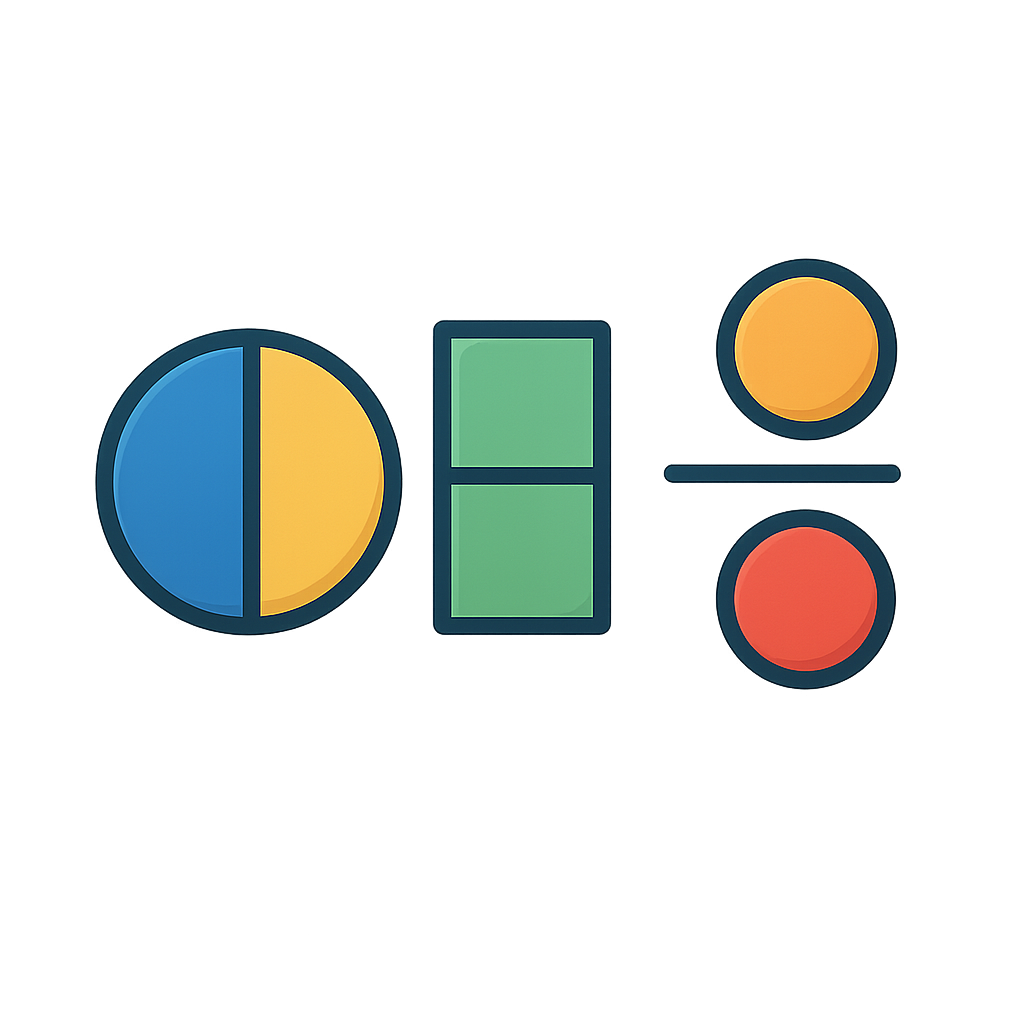
A Piece of the Whole: The Story of Fractions
Have you ever felt like you were just one part of a bigger picture? Like a single slice of a warm, cheesy pizza waiting to be shared, or a scoop of flour that isn't the whole bag, but just enough for the cookie recipe? I exist in those in-between spaces. You can feel me when you look up at the night sky and see the moon as a glowing silver crescent, a piece of a promise of the full moon to come. I am the silence between musical notes, the half-empty glass of water, the single chapter in a long and exciting book. For thousands of years, people felt my presence every time they needed to share, measure, or build. They knew about parts and they knew about wholes, but they struggled to find a single, simple language to describe me. They needed a way to talk about things that were not quite one, but more than zero. They needed a way to be fair when dividing a harvest, to be precise when cutting stone for a pyramid, and to be clear when passing down a recipe. I was an idea waiting for a name, a concept that lived in every marketplace, kitchen, and workshop. I am the logic of sharing, the mathematics of a portion. I am Fractions.
My journey to become the clear and helpful tool you know today was a long one, stretching across deserts and empires. My story really begins in the fertile lands of ancient Egypt, more than 4,000 years ago. Every year, the great Nile River would flood its banks, nourishing the soil but also washing away the markers that divided the farmers’ lands. When the waters receded, the land had to be redistributed fairly. How do you give someone back exactly their portion? The Egyptians needed me. Their scribes were brilliant, and they developed a system to write me down, but it was a bit peculiar. They mostly thought of me in terms of unit fractions, where the top number is always one: one-half, one-third, one-eighth, and so on. To represent more complex parts, like three-fourths, they had to add my unit pieces together, like one-half plus one-fourth. It worked, but it could get complicated. Then came the ambitious ancient Romans. They loved order and practicality, and they used me for their commerce and engineering. Their system was based on the number twelve, dividing a whole unit, which they called an 'as', into twelve smaller parts called 'unciae'. This was useful for their currency and measurements, but it was still tied to a specific base. I was still waiting for a way to be truly universal. The key to my new life came from the East. In India, brilliant thinkers were exploring numbers in revolutionary ways, creating the decimal system and giving the world the powerful idea of zero. This work traveled along trade routes to the Arab world, where scholars in bustling centers of learning studied and expanded upon it. It was there, in the 12th century, that a mathematician from Morocco named Al-Hassar gave me the look I have today. He had a simple, yet revolutionary idea: a horizontal bar to separate the parts you have from the total parts of the whole. He called the top number the numerator—the 'counter'—and the bottom number the denominator—the 'namer'. Suddenly, I was clear. Three-fourths was no longer a clumsy addition problem; it was a simple and elegant 3 over a 4. This small line, the vinculum, changed everything. It made me easy to understand, to compare, and to calculate with. My modern form was finally born.
Now, I am everywhere, often working so quietly you don’t even notice me. When you glance at a clock and see that it’s quarter past the hour, that’s me dividing time. When you follow a recipe that calls for two-thirds of a cup of sugar, I am there ensuring your cake turns out perfectly. But my work goes far beyond the kitchen. I am the very soul of music. The length of a note—a whole note, a half note, an eighth note—is determined by me, creating the rhythm and flow that makes you want to dance. In the digital world, I am essential. Computer programmers use me to scale images on your screen, to calculate probabilities in games, and to manage how a computer's memory is allocated. Architects and engineers rely on me to design stable bridges and towering skyscrapers, ensuring every component fits with absolute precision. In the world of finance, people talk about owning a fraction of a company through stocks or paying a fraction of a price during a sale. I am a language of precision, fairness, and connection. I show you that a whole is made of many important parts and that even the smallest piece has its place. I help you understand that sharing doesn't mean losing something, but creating balance. I am a reminder that the world is a beautiful, intricate puzzle, and by understanding its pieces, we can better understand the magnificent whole.
Reading Comprehension Questions
Click to see answer