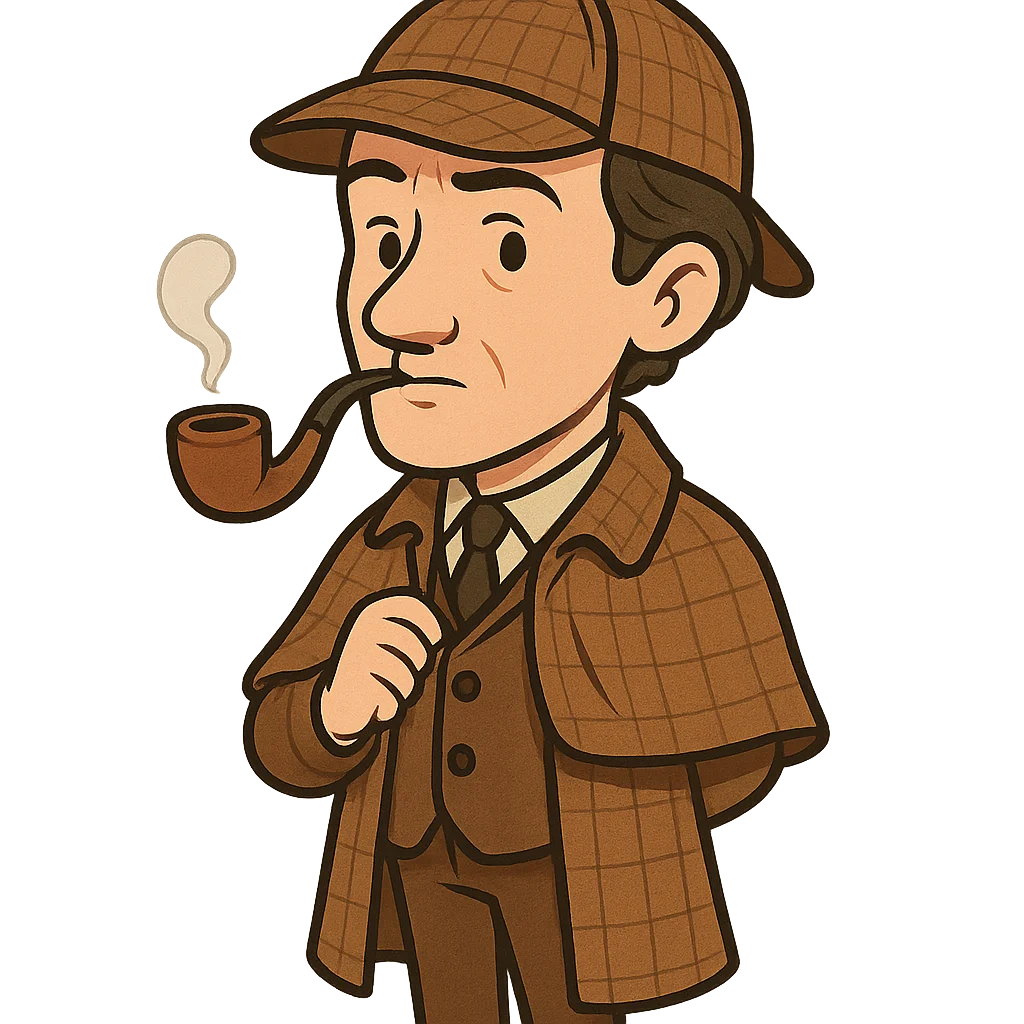
A Study in Deduction: My Life as Sherlock Holmes
Allow me to introduce myself. My name is Sherlock Holmes, and I am known to many as the world's only consulting detective. You might have heard of my adventures in the fog-laden streets of London, solving mysteries that have left even the most experienced police officers completely stumped. Now, I must confess something to you from the very beginning: while I may seem quite real, I am, in fact, a character. I was brought to life by the brilliant mind of an author named Sir Arthur Conan Doyle. He imagined me and my world, creating a place for my unique profession to thrive. You see, I am not an ordinary detective. When Scotland Yard is baffled, when a case seems impossible, they come to me. My work is my passion, and I treat each mystery as a fascinating puzzle waiting to be solved. My secret is what I call the science of deduction. It is a simple method, really. I observe the details that everyone else overlooks. A smudge of dirt on a trouser leg, a tiny scratch on a watch, or the type of ash left behind by a cigar—these are the clues that tell me the whole story. While others see, I observe, and in that small difference lies the key to solving any crime.
My story first became known to the public in November of 1887, in a book titled 'A Study in Scarlet.' It was during this very first case that I met the man who would become my most loyal friend and trusted colleague, Dr. John H. Watson. He was an army doctor, recently returned to London and in search of a place to live. As fate would have it, so was I. We were introduced by a mutual acquaintance and soon decided to share lodgings at a most famous address: 221B Baker Street. Our rooms were kept by our patient and kind landlady, Mrs. Hudson, who grew accustomed to the strange visitors and scientific experiments that became a part of our daily life. Dr. Watson was fascinated by my methods, and he soon began to accompany me on my investigations. He was more than just a companion; he was the one who chronicled our adventures. With his pen, he shared our cases with the world, ensuring that my methods and our most thrilling pursuits would not be forgotten. He was the biographer I never knew I needed, and a friend I would always value.
I have always lived by a simple philosophy: 'the world is full of obvious things which nobody by any chance ever observes.' It is this belief that has guided me through my most perplexing cases. By focusing on the evidence before me and applying cold, hard logic, I could uncover truths hidden in plain sight. I recall some of these adventures with great fondness, for the thrill of the intellectual chase—the 'game,' as I called it—was everything to me. One of my most memorable investigations was the terrifying case of 'The Hound of the Baskervilles,' a mystery that involved a supposed supernatural beast haunting a family on the moors. Another was 'The Adventure of the Speckled Band,' a clever and sinister puzzle set within a locked room. In my many years, I faced countless criminals, but there was one person who was not a criminal at all, yet managed to outwit me. Her name was Irene Adler. She was a remarkable and brilliant woman who earned my complete and everlasting respect. Each case was a unique challenge, a test of my abilities, but each one proved that no matter how complex the problem, it could always be unraveled with careful observation and logical deduction.
For every great detective, there must be an equally great adversary. Mine was a man named Professor James Moriarty. He was not a common criminal, but a genius of the highest order—a brilliant mathematician whose mind was a match for my own. I often referred to him as the 'Napoleon of Crime,' for he was the mastermind behind a vast web of illegal activities, yet he remained untouchable by the law. His intellect was something I could respect, but his evil was something I had to stop. My creator, Sir Arthur Conan Doyle, felt that my story had run its course, and he decided that my career must come to a dramatic end. In a story published on December 1st, 1893, titled 'The Final Problem,' I finally confronted Moriarty. Our final struggle took place at the top of the breathtaking Reichenbach Falls in Switzerland. There, locked in a desperate battle, it seemed that both of us plunged over the edge and into the churning water below, lost forever.
However, the public was not quite ready to let me go. Readers from all over the world were saddened by my apparent demise and wrote letters demanding my return. After several years of public pressure, Sir Arthur Conan Doyle graciously obliged. In 1903, I made my dramatic reappearance in a story called 'The Adventure of the Empty House.' You can only imagine the shock and immense joy of my dear Dr. Watson when he saw me standing before him once again, alive and well. I explained that I had not fallen but had used the opportunity to dismantle the rest of Moriarty's criminal network. I resumed my work as a consulting detective, and my adventures continued for many more years, with my very last story being published in 1927. Though my stories have concluded, my legacy lives on. I hope my tales encourage you to look at the world a little differently, to pay attention to the small details, and to use the power of your own mind to solve the puzzles you encounter. The spirit of adventure and the science of deduction belong to everyone. I lived many years and passed away later in life, but the game is always afoot.
Reading Comprehension Questions
Click to see answer