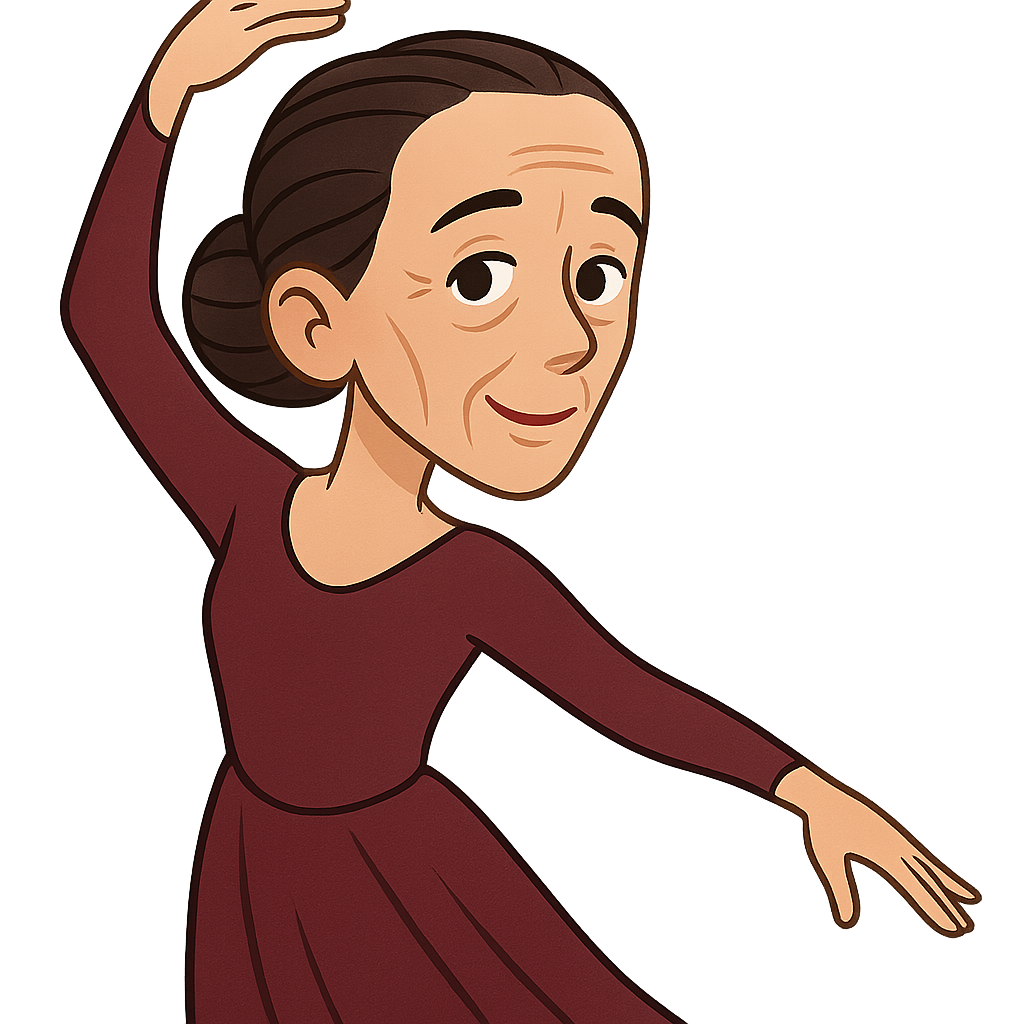
Martha Graham: A Life in Movement
Hello. My name is Martha Graham, and I am known as one of the pioneers of modern dance. My story begins not on a grand stage, but in a small town called Allegheny, Pennsylvania, where I was born on May 11, 1894. My father, George Graham, was a doctor who specialized in nervous disorders, and he taught me something I never forgot. He would watch how people moved—their posture, their walk, their gestures—and he would tell me, “Martha, movement never lies.” He believed that the body could tell the truth even when words could not. This idea planted a seed in my young mind that would blossom into my life’s work. When I was a teenager, my family moved across the country to the warm, sunny climate of Santa Barbara, California, in 1908. The world there felt wide open and full of possibilities. It was in California, in the year 1911, that my life changed forever. My father took me to see a performance by the famous dancer Ruth St. Denis. Watching her move on stage, draped in exotic costumes and telling stories with her body, was not just an experience; it was a lightning bolt of inspiration. In that theater, I saw my future. I knew, with a certainty that filled my entire being, that I was meant to be a dancer.
Unlike many dancers who begin their training as small children, I started my journey much later. It wasn't until 1916, at the age of 22, that I finally enrolled in a professional school—the Denishawn School of Dancing and Related Arts in Los Angeles. It was a wonderful place, run by the very woman who had inspired me, Ruth St. Denis, and her husband, Ted Shawn. They taught me so much about technique and performance, and I even became a teacher and one of their featured dancers. But as the years went on, I felt a growing restlessness inside me. The dances we performed were beautiful, often inspired by the cultures of Egypt, India, and Spain, but they didn't feel like they were telling my story. They felt decorative, like beautiful paintings, but I wanted my dancing to feel like a novel—full of struggle, emotion, and the raw truth of the human experience. I wanted to express what it felt like to be a modern American. In 1923, I made the difficult and risky decision to leave Denishawn and move to New York City to find my own voice. On my own in the bustling city, I knew I had to create something entirely new. So, in 1926, I founded my own dance company, a small group of dedicated female dancers who believed in my vision. This was the true beginning of my revolution.
My big idea, the very foundation of my new language of movement, came from the most basic human action: breathing. I called my technique “contraction and release.” Think about what happens when you are suddenly frightened or when you sob—your torso curves inward in a sharp contraction. And when you feel relief or joy, you breathe out and your body opens up in a release. I built my entire dance vocabulary on this powerful, natural rhythm. My dance was not light and airy like ballet; it was grounded, sharp, and often angular. It showed effort and struggle because I believed that was where true beauty and honesty lived. With this new language, I began to create dances that explored the depths of the human psyche. In 1930, I created a solo called “Lamentation,” where I sat on a bench encased in a tube of stretchy purple fabric. I never showed my face, but the audience could feel the shape of grief through the tension and pulling of the material around my body. My most celebrated work, “Appalachian Spring,” premiered in 1944. For this piece, I had a wonderful collaboration with the composer Aaron Copland, who wrote a soaring, hopeful musical score, and the brilliant sculptor Isamu Noguchi, who designed a simple, powerful set. The dance told the story of American pioneers building a home and a life on the frontier. For years, my company was made up of only women, but in 1938, I invited Erick Hawkins to join, making him the first man to dance with us. His presence opened up new dramatic possibilities, allowing me to explore the complex relationships between men and women on stage.
I lived a very long life dedicated to my art. I performed on stage until I was 76 years old, giving my final performance in 1969. Even after my body could no longer handle the demands of performing, my mind never stopped creating. I continued to choreograph new dances, pushing the boundaries of my art form almost until the very end. When I first began, my style was shocking to many people. They called it ugly and strange because it wasn't the graceful, floating movement they were used to. But it was my truth, and I knew I had to follow it. My journey on this earth came to an end in 1991, when I passed away at the age of 96. But my movement, my ideas, and my dances live on. My technique is now taught in schools all over the world, and my company continues to perform my work, inspiring new generations of artists. My message to you is this: your body is a sacred garment. It holds your stories, your joys, and your sorrows. Dance is the hidden language of the soul, a way to express all the things for which we have no words. I encourage you to find your own way to move, your own way to tell your story. Don't be afraid to be different. The world needs your unique voice, and through movement, you can share it with everyone.
Reading Comprehension Questions
Click to see answer