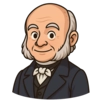
A Life of Service: My Story
Hello, my name is John Quincy Adams, and my life was woven into the very fabric of the United States, a nation I watched being born. I began my story not in a time of peace, but in a world turned upside down by revolution. I was born in Braintree, Massachusetts, on July 11, 1767. My father was John Adams, a lawyer and patriot who would become the second president, and my mother was the brilliant and steadfast Abigail Adams. From my earliest days, the air buzzed with talk of liberty and tyranny. I did not learn about the American Revolution from a book; I lived it. I vividly remember one particular day, June 17, 1775. I was not yet eight years old when my mother took me to the top of Penn’s Hill, near our farm. From there, we could see the smoke rising and hear the thunder of cannons from the Battle of Bunker Hill across the water in Charlestown. It was a frightening and powerful sight, one that forever impressed upon me the great cost of freedom. My father was often away in Philadelphia at the Continental Congress, helping to guide the colonies toward independence, and my mother’s letters to him were full of news, advice, and a fierce love for our new country. Her courage and intellect were my first and most important education. In 1778, when I was only ten, my father was sent to France as a diplomat, and he took me with him. The journey across the stormy Atlantic Ocean was perilous, but it opened my eyes to a world far beyond our Massachusetts farm. This early exposure to different cultures, languages, and the complex art of diplomacy shaped the course of my entire life, marking the beginning of a long career serving my country on foreign shores.
My education in service to my country continued at a rapid pace. While still a teenager, my life took another extraordinary turn. In 1781, at the age of fourteen, I traveled to St. Petersburg, Russia, to serve as the private secretary and French translator for Francis Dana, America’s first envoy to that distant empire. It was an immense responsibility for someone so young, but I dedicated myself to the task, learning much about the delicate dance of international relations. After two years, I returned to America to complete my formal education, enrolling at Harvard College and graduating in 1787. I then studied law and opened a practice in Boston, but my heart was never truly in it. The call to serve the United States, this republic my father had helped create, was too strong to ignore. In 1794, President George Washington appointed me as the United States minister to the Netherlands. This began a long period of my life spent overseas, representing our nation’s interests. My diplomatic posts took me from the Netherlands to Portugal, and then to Prussia. It was during this time, in London, that I met the most wonderful person, Louisa Catherine Johnson, the daughter of the American consul. We were married in 1797, and she became my devoted partner through all the challenges and travels that lay ahead. My most significant diplomatic achievement came years later. After serving in the United States Senate and as minister to Russia once again, I was appointed in 1814 to lead the American commission to negotiate an end to the War of 1812 with Great Britain. The negotiations in the city of Ghent, in what is now Belgium, were long and difficult. But after months of patient and determined argument, we signed the Treaty of Ghent on Christmas Eve of 1814, officially ending the war and restoring peace. It was a moment of profound satisfaction to have helped secure our nation's sovereignty once again.
After the success of the Treaty of Ghent, I returned to America in 1817 to take on a new role: Secretary of State for President James Monroe. This eight-year period was one of the most productive of my career. I worked to expand our country's territory, negotiating the treaty with Spain that added Florida to the United States. My most enduring contribution from this time, however, was helping to shape what became known as the Monroe Doctrine. In 1823, we issued a bold statement to the world, declaring that the American continents were no longer subject to colonization by European powers. We were sending a clear message: our hemisphere was our own, and the United States was ready to stand as a guardian of its independence. Then came the most complicated and controversial moment of my political life: the presidential election of 1824. Four of us ran for president, and when the votes were counted, no one had a majority in the Electoral College. The decision went to the House of Representatives. Andrew Jackson had won the most popular votes, but with the support of another candidate, Henry Clay, the House elected me as the sixth president. When I then appointed Mr. Clay as my Secretary of State, Jackson’s supporters were enraged, calling it a 'corrupt bargain.' Their anger cast a long shadow over my entire presidency. From 1825 to 1829, I served my single term in the White House. I had ambitious ideas for the nation. I proposed a grand system of national improvements, including new roads, canals, and harbors to connect our vast country. I called for the creation of a national university and a naval academy to advance learning, and government-funded observatories to study the stars. But my political opponents in Congress, who were already planning for Jackson's next campaign, viewed these ideas with suspicion and blocked them at every turn. It was a deeply frustrating time, but though my presidency was a difficult one, I never stopped believing in the power of government to work for the good of the people.
Losing the presidency to Andrew Jackson in the election of 1828 could have been the end of my public life. At that time, former presidents were expected to retire gracefully to their farms. But I was not built for a quiet retirement. In 1830, the people of my home district in Massachusetts asked me to represent them in Congress, and I accepted. This decision, to return to Washington not as president but as a member of the House of Representatives, was something no former president had ever done, and it began the chapter of my life of which I am most proud. For the next seventeen years, I found a new voice and a new purpose. I earned the nickname 'Old Man Eloquent' for my passionate and tireless speeches. My greatest fight was against the expansion of slavery. In 1836, pro-slavery members of Congress passed a 'gag rule,' which automatically tabled any petitions related to slavery, preventing them from even being discussed. I saw this as a violation of the constitutional right of the people to petition their government, and I fought against it relentlessly year after year. My most famous battle for justice came in 1841 with the Amistad case. A group of Africans had illegally been taken from their homes, sold into slavery, and had bravely seized control of the ship, the Amistad, that was transporting them. Their case went all the way to the Supreme Court. Though I was 73 years old and had not argued a case in decades, I agreed to represent them. I stood before the court and argued for their natural right to be free. We won, and the Amistad captives were able to return to their homes in Africa. My life of service ended where I felt I most belonged. On February 21, 1848, I suffered a stroke on the floor of the House of Representatives. Two days later, my life came to an end. My journey taught me that a person's most important work can come at any stage of life, and that the duty to fight for what is right never ends.
Reading Comprehension Questions
Click to see answer