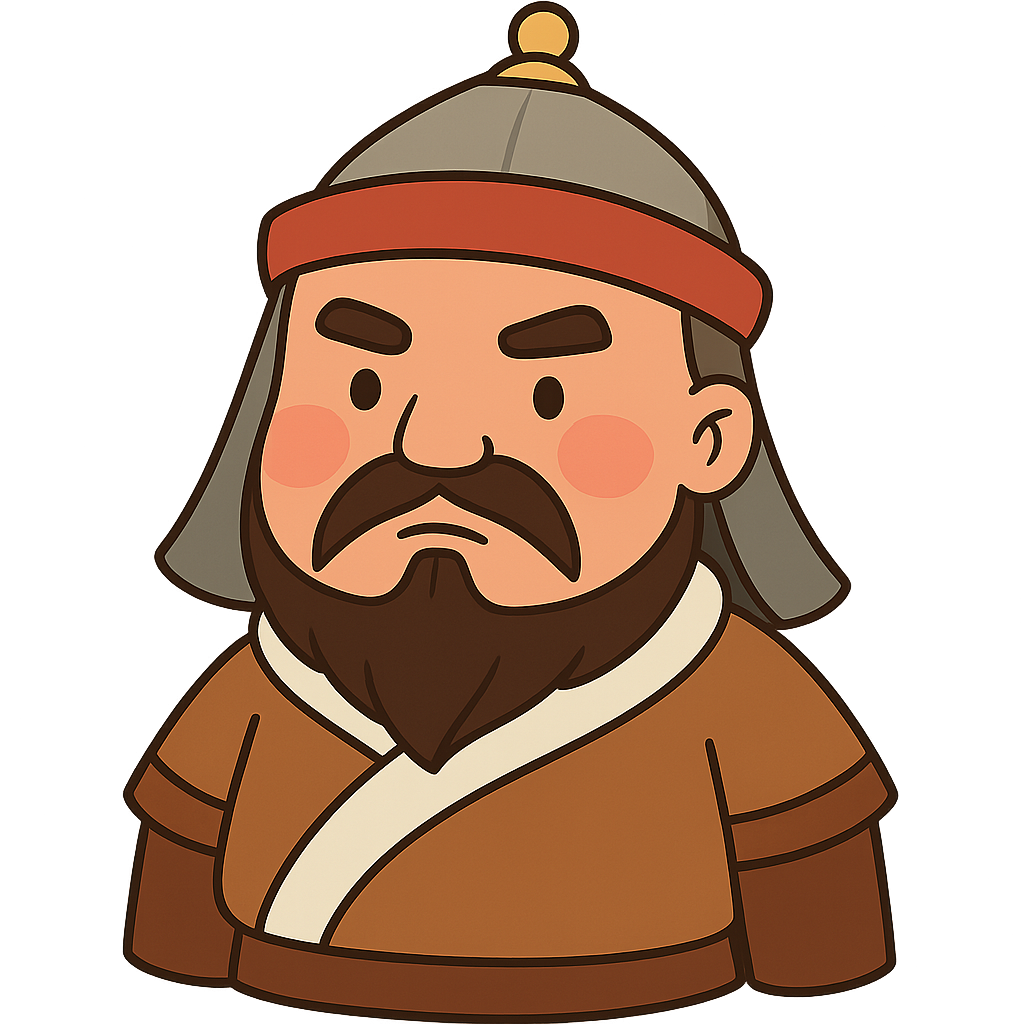
Genghis Khan: The Boy Who United the World
Before the world knew me as Genghis Khan, the great ruler, I was a boy named Temujin. I was born around the year 1162 on the vast, windy plains of Mongolia. My world was an ocean of grass under an endless blue sky, a harsh but beautiful land where my people lived as nomads. We moved with the seasons, our homes were felt tents called gers, and our greatest companions were our horses. My father, Yesügei, was the respected leader of our clan. He taught me how to ride a horse before I could properly walk, how to hunt with a bow and arrow, and the most important lesson of all: that our strength came from our unity. He would often tell me, "A single arrow is easily broken, but a bundle of arrows is unbreakable."
Those lessons became my lifeline when I was only nine years old. My father was poisoned by a rival tribe, and his world ended in an instant. In the brutal world of the steppe, a clan without a strong leader was vulnerable. Our own people, the very ones my father had led, saw my family as a burden. They abandoned us—my mother Hoelun, my siblings, and me—leaving us to survive alone in the wilderness. The hunger was a constant ache in my stomach. We ate wild roots, fished in the cold rivers, and hunted whatever small animals we could catch. Those years were incredibly difficult, but they did not break me. Instead, they forged my will to survive. I learned that loyalty was more precious than gold and that I could not rely on old traditions or birthright. I had to create my own destiny, one built on strength, determination, and the trust of those who stood by me.
Hardship can either break a person or make them stronger, and I chose to become stronger. As a young man, I began to gather followers. My first great test came when my wife, Börte, was captured by a rival tribe called the Merkits. My heart burned with a need for justice. I knew I couldn't rescue her alone, so I sought help from my father’s old ally, Toghrul, and my childhood friend, Jamukha, who I had sworn an oath of brotherhood with, making us ‘anda.’ Together, we defeated the Merkits and rescued Börte. This victory was the first step on my long journey, earning me respect and a reputation as a capable warrior and leader. Warriors began to flock to my side, not because I was the son of a chief, but because they saw that I valued skill and loyalty above all else. I promoted my best generals based on their merit, not their family name, which was a revolutionary idea at the time.
This new way of thinking put me in direct conflict with my old friend, Jamukha. He believed in the traditional aristocratic system, where only nobles could rule. Our friendship slowly turned into a bitter rivalry, and the Mongol tribes were forced to choose a side. The struggle to unite our people was long and filled with battles and betrayals. For nearly two decades, we fought to bring all the warring clans under one banner. Finally, after defeating all my rivals, I called for a great assembly, a ‘kurultai,’ in the year 1206. On the banks of the Onon River, the leaders of every tribe gathered. They declared me the leader of all the people of the felt-walled tents and gave me a new title: Genghis Khan, the ‘universal ruler.’ The boy named Temujin was gone; a new era had begun.
Uniting the tribes was only the beginning. My true goal was to create a nation that would last for centuries, a place of order and connection. One of the first things I did was command a scholar to create a written alphabet for our language. For the first time, our history and our laws could be recorded and shared. I established a code of laws called the Yassa, which applied to everyone, from the lowest soldier to my own family. It punished theft and fighting among our people, creating a level of peace and safety that the steppes had never known. The Yassa also guaranteed religious freedom, allowing Christians, Muslims, and Buddhists to practice their faith without fear throughout my lands.
To connect my vast empire, I created one of my greatest innovations: the Yam. This was a postal service like no other, a network of relay stations with fresh horses and riders ready to go at a moment's notice. A message could travel over 200 miles in a single day, an incredible speed for that time. It was the information highway of the 13th century. I also used my armies to secure the famous Silk Road, the ancient trade route that connected Asia with the Middle East and Europe. For centuries, it had been plagued by bandits, but under my rule, it became so safe that people said a young woman could walk from one end of the empire to the other carrying a sack of gold and never be harmed. This safety allowed not just goods like silk and spices to travel, but also ideas, inventions, and cultures, connecting the East and West in a way the world had never seen before.
From a starving, abandoned boy on the steppe to the ruler of the largest land empire in history, my life was a journey I could never have imagined. My path was not always easy, but it was driven by a vision of a united and connected world. In the summer of 1227, while on a military campaign, my time on this earth came to an end. But my work did not end with me. I left behind a legacy carried on by my sons and grandsons, like my son Ögedei, who continued to govern and expand the empire we had built. The world was forever changed, not by conquest alone, but by the connections we forged. My story is proof that no matter how humble your beginnings, with perseverance and a clear vision, one person has the power to unite people and change the world.
Reading Comprehension Questions
Click to see answer