Genghis Khan: The Boy Who United the Steppes
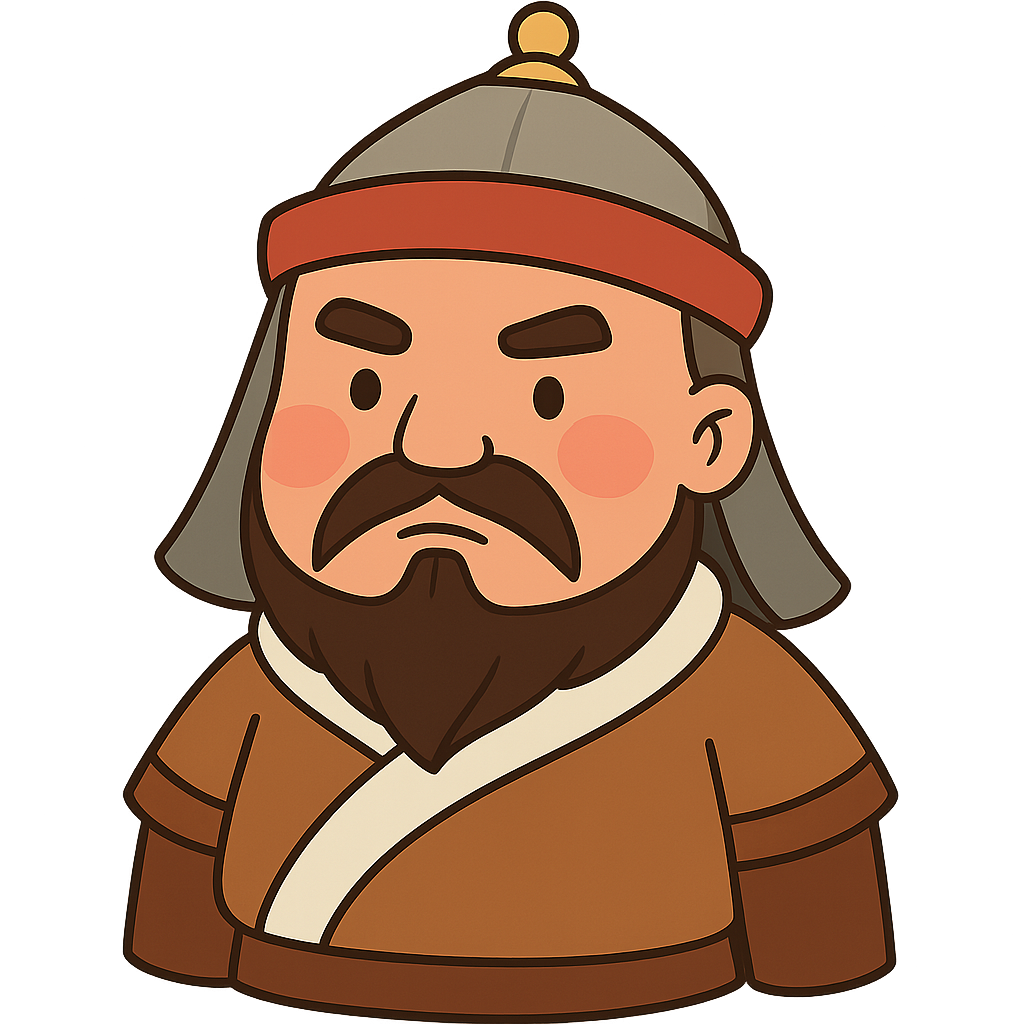
Hello, my name is Temüjin, and my story begins on the wide, windy plains of Mongolia, where I was born around the year 1162. Life on the steppe was a grand adventure. The sky was our roof, and the earth was our floor. As a boy in a nomadic tribe, I learned to ride a horse almost as soon as I could walk. We moved with the seasons, following our herds of sheep and goats. My father, Yesügei, was a respected leader, and he taught me how to hunt with a bow and arrow and how to read the signs of the land. Our family was everything. We relied on each other for warmth, for food, and for safety. Life was hard but good, until one terrible day. When I was just nine years old, my father was poisoned by our rivals, the Tatars. In an instant, my world fell apart. Our own tribe, seeing that we were now without a strong leader to protect us, drove us away. My mother, Hoelun, my siblings, and I were left all alone on the harsh steppe with nothing. We ate roots and hunted for small animals just to survive. That cold and hunger taught me a lesson I would never forget: to be weak was to be in constant danger. I knew I had to become strong, not just for myself, but to protect the family I had left.
As I grew from a boy into a young man, the memory of my family's suffering fueled a fire inside me. I was determined to reclaim my family's honor. My first big challenge came when my new wife, a wonderful woman named Börte, was captured by a rival tribe. I was heartbroken, but I refused to give up. I knew I couldn't rescue her alone. I rode to find allies, including my childhood friend, Jamukha, and a powerful leader my father had known, named Toghrul. Together, we planned a daring rescue. The battle was fierce, but we were victorious, and I brought Börte home safely. That victory changed everything. Other warriors saw my courage and my loyalty, and they began to follow me. As I looked around, I saw that all the Mongol tribes were like scattered arrows—easily broken one by one. They were always fighting each other, which kept everyone poor and weak. I had a dream of bundling all those arrows together, to unite every tribe under one banner so we could be strong and unbreakable. It wasn't easy. It took many years of clever plans, daring battles, and proving that I was a leader who could be trusted. I rewarded loyalty fiercely and created a powerful army. Finally, in the year 1206, all the leaders of the tribes I had united gathered for a great meeting called a kurultai. There, on the open steppe, they declared me their one true leader. They gave me a new name, a title of great honor: Genghis Khan, which means 'universal ruler'.
Becoming Genghis Khan was not the end of my journey; it was a new beginning. I wasn't just a warrior anymore; I was the builder of a nation. I knew that to keep my people united, we needed more than just a strong army. We needed rules to live by and ways to connect our vast lands. So, I asked a wise man to create a written language for our people, so our stories and laws could be written down for the first time. I created a code of laws called the Yassa, which treated everyone fairly and established order. To help us communicate, I established the Yam, a messenger system where riders on fast horses could carry messages across the land like lightning. This connected every corner of my growing empire. We made the trade routes, like the famous Silk Road, safe for merchants to travel, which allowed new ideas, inventions, and goods to be shared between the East and the West. My life's journey ended in the year 1227, but the empire I built continued to grow, becoming the largest the world had ever seen. My story shows that even a boy who starts with nothing can change the world if he has the courage to unite people for a common dream.
Reading Comprehension Questions
Click to see answer