Christopher Columbus: A Journey Across the Ocean
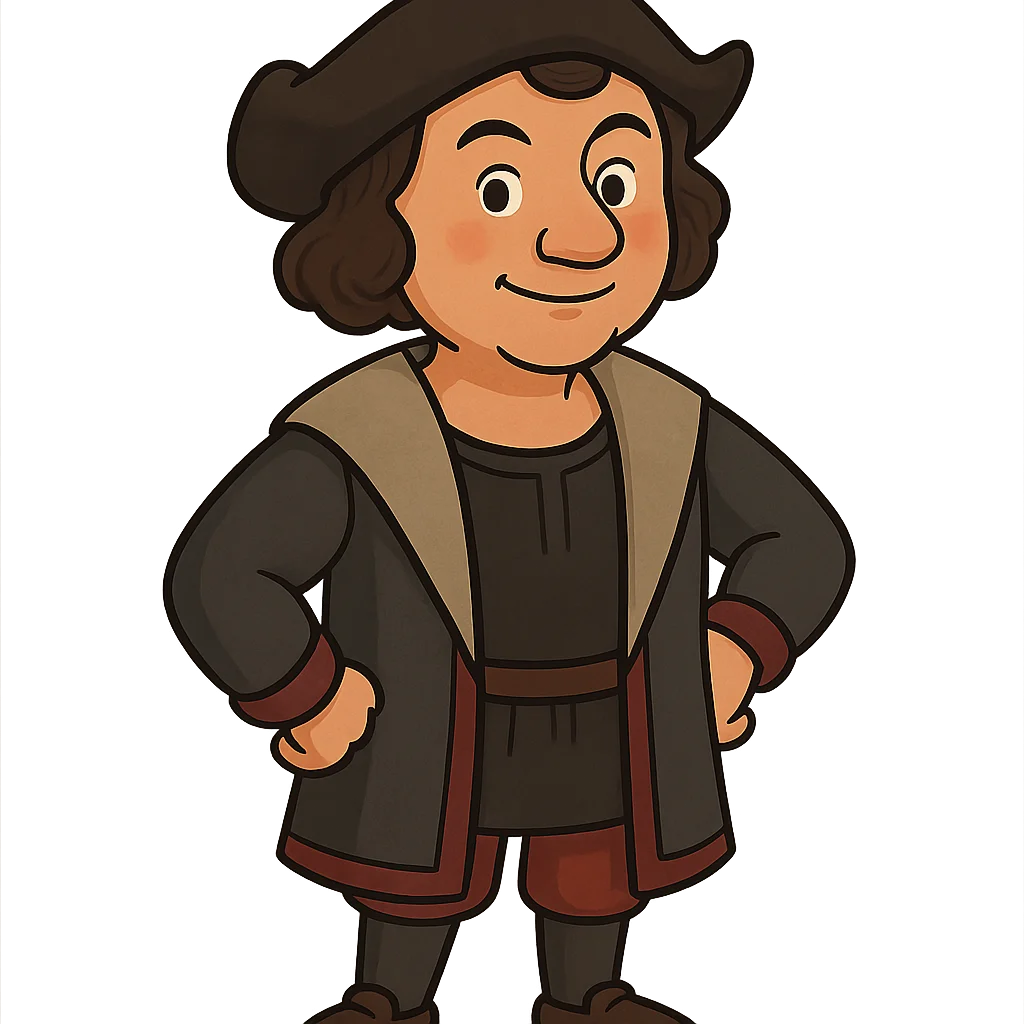
Hello, my name is Christopher Columbus, and I am known for sailing across the great Atlantic Ocean. I was born around the year 1451 in Genoa, Italy. Genoa was a wonderful place to grow up because it was a busy port city, filled with the sights and sounds of the sea. Tall ships from faraway lands were always arriving and departing, their sails like giant white wings against the blue sky. My father was a wool weaver, a fine and steady job, but my heart was always pulled toward the water. I spent hours watching the sailors, studying the maps that showed the known world, and dreaming of my own adventures. I was fascinated by the idea of exploration and believed something that most people at the time thought was impossible. I was sure that the world was round, not flat. This gave me a very big idea: if the world was a sphere, then I could reach the rich lands of the East, known as the Indies, by sailing west instead of east. It was a dream that would take me on the greatest journey of my life.
My dream was big, but turning it into a reality was a huge challenge. To sail across an unknown ocean, I needed ships, a crew, and a lot of money for supplies. I couldn't do it alone, so I needed a sponsor, like a king or queen, to believe in my idea. First, I went to the King of Portugal with my maps and my plans, but he told me 'no.' I asked many other rulers for help, but time and again, the answer was the same. Many people did not believe the journey was possible and thought it was too risky. But I refused to give up. I traveled to Spain to speak with King Ferdinand and Queen Isabella. For many years, I waited patiently, explaining my idea and asking for their support. Finally, after a very long wait, they agreed to sponsor my voyage in the year 1492. I was overcome with excitement. At last, my dream was coming true. I immediately began to prepare for the journey, getting my three ships ready. Their names were the Niña, the Pinta, and the Santa María. Everything was finally falling into place.
On August 3rd, 1492, my three ships and I set sail from Spain, heading west into the vast, unknown Atlantic Ocean. The first few weeks were filled with hope, but as the days turned into weeks with no sight of land, my crew grew nervous. They had never been so far from home, and all they could see in every direction was an endless blue sea. They became scared and restless, and many of them wanted to give up and turn the ships back toward Spain. It was a difficult time, and I had to encourage them to keep going, reminding them of the riches and glory that awaited us in the Indies. I urged them to have faith for just a little longer. Then, in the early morning of October 12th, 1492, a lookout shouted the words we had all been waiting to hear: 'Land. Land.'. It was a moment of pure joy and relief. We had made it. I landed on a beautiful island in what is now known as the Bahamas. There, we met the people who already lived on the island, the Taíno. Because I was certain I had reached the Indies, I called these people 'Indians,' a name that would stick for centuries to come.
Returning to Spain was an amazing experience; I was treated as a hero for my discovery. Everyone was amazed that I had successfully sailed west and found land. This first journey was just the beginning. I ended up making three more voyages across the ocean, exploring more islands and parts of the continents that would later be called the Americas. My journeys connected two parts of the world that had never been connected before, Europe and the Americas. This started a new era of exploration, as many other sailors followed my path across the sea. My voyages changed the world map forever. I lived many more years after my travels, and I always remembered my first journey across the great ocean, sailing into the unknown with nothing but a dream and a belief that the world was round.
Reading Comprehension Questions
Click to see answer