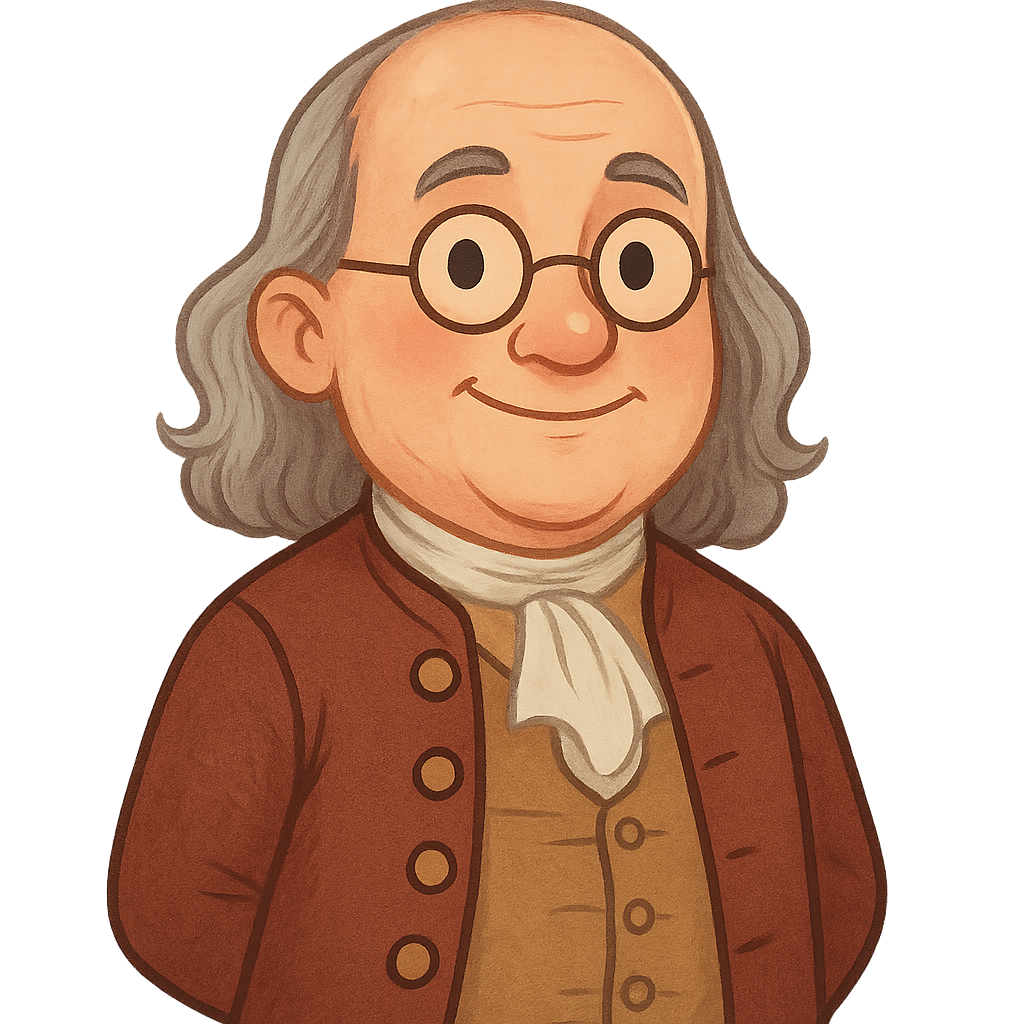
The Story of Benjamin Franklin
Hello there! My name is Benjamin Franklin, and I have a story to tell you about a life filled with curiosity, big ideas, and a few sparks of electricity! My journey began way back on January 17, 1706, in the busy city of Boston. I was the 15th of 17 children, so our house was always noisy and crowded! With so many siblings, I learned to be clever and make my own way. My greatest love was reading. I would save every penny I could to buy books. They were like windows to the whole world, and I wanted to see everything.
When I was twelve, I went to work as an apprentice for my older brother, James, who owned a printing shop. I loved the smell of the ink and the clatter of the printing press, but James didn't always take my ideas seriously. I knew I had good things to say, so I came up with a secret plan. I started writing letters at night, full of clever thoughts and funny observations about life in Boston. I signed them with a made-up name: Mrs. Silence Dogood. I would slip them under the print shop door, and my brother, not knowing they were from me, loved them! He printed every single one in his newspaper. It was my secret, and it taught me that a good idea is a good idea, no matter who it comes from.
As much as I loved Boston, I knew I needed to find my own path. So, at seventeen, I made the bold decision to leave home and start a new life in Philadelphia. I arrived in 1723 with only a few coins in my pocket, feeling tired and hungry, but my heart was full of ambition. I worked hard and soon opened my own printing shop. I printed my own newspaper, the Pennsylvania Gazette, and I also created a little book that became very popular called Poor Richard's Almanack. It was filled with calendars, weather forecasts, poems, and wise sayings like, "A penny saved is a penny earned."
But I wanted to do more than just run a business; I wanted to make my new city a better place for everyone. I saw that my friends loved borrowing my books, so I thought, why not create a place where everyone could borrow books? That idea led me to start America's first lending library in 1731. I also saw how dangerous fires were, so I organized the city's first volunteer fire department. Later, I helped start a hospital for people who were sick and couldn't afford care. I believed that when we work together, we can solve any problem.
My curiosity didn't stop with books and city planning. I was fascinated by the natural world, especially the mysterious and powerful force of electricity. People saw lightning in the sky, but no one really knew what it was. I had a theory: I believed that lightning was a form of electricity, just like the sparks we could create with our machines. To prove it, I planned a very dangerous experiment. During a thunderstorm in 1752, my son and I went out into a field with a kite that had a metal key tied to the string. As the storm cloud passed over, I saw the loose threads on the kite string stand up. I carefully brought my knuckle close to the key, and ZAP! A spark jumped to my hand. I had proven that lightning was indeed electricity! This discovery led me to invent the lightning rod, a simple metal pole that could be placed on top of buildings to safely guide lightning into the ground, saving countless homes from fires. I never stopped trying to invent things to make life easier, like bifocal glasses so I could see both near and far, and a special stove that heated rooms much better than an open fireplace.
As I got older, my work turned toward helping not just my city, but all thirteen American colonies. We were being ruled by the king of England, who lived an ocean away. Many of us felt that his rules were unfair. We believed we should be able to govern ourselves. In 1776, I was given a very important job: I was asked to help write the Declaration of Independence. It was a letter to the king, telling him that we were creating our own new nation, the United States of America. During the war that followed, I sailed to France to ask for their help, and they agreed! After we won our freedom, I helped write the United States Constitution in 1787, which is the set of rules our country still follows today. It was an honor to help build the foundation for a brand new country based on liberty and justice.
My long and busy life came to an end in 1790, but my story didn't. Looking back, I see that my whole life was guided by a few simple ideas. Always be curious. Never stop learning. And most importantly, ask yourself what you can do—big or small—to help your neighbors and your community. If you live by those ideas, you too can make the world a better place.
Reading Comprehension Questions
Click to see answer